


In This Article
- 01What Jev is and where it fits
- 02How Jev answers a question
- 03What happened when we tested it
- 04RFQ triage is the strongest case
- 05Spec extraction needs code to do the reading
- 06Quote and document checks are a first pass
- 07Export-control and end-use questions stay with a person
- FAQFrequently Asked Questions
Key Takeaways
- ◆TypeSafe AI launched Jev on 15 September 2026 and opened it to everyone on 20 September. Jev answers three question types (Choice, Score and Noul) with probabilities and does not write text. Input is text only, and English is where its accuracy is best.
- ◆We tested Jev on invented order-desk email on 20 and 21 September 2026. It handled account matching correctly in 10 of 10 clean cases plus 2 of 2 reruns, and no email was filed to the wrong job, but at thresholds of 0.98 and 0.90, set before the test, it settled only 1 of the 11 messages it should have handled on its own. We do not run it on customer email.
- ◆RFQ triage is the strongest fit: one Choice over five part families plus a 'not a magnet enquiry' option, and three yes/no questions on drawing, quantity and operating temperature, with low-confidence answers routed to a person.
- ◆On TypeSafe's invoice-processing benchmark Jev agreed with the reference answers 61.8% of the time, against 78.4% to 79.1% for the strongest language models, and the reference answers were the average of two other language models. Supplier-document checks should be a first pass that escalates to a person.
- ◆In a test published on the Octomind blog on 18 September, one injected 'pre-approved' field cut Jev's probability of blocking a destructive shell command from 0.76 to 0.48; the verdict stayed 'block' with a much smaller margin. A model can flag export-control and end-use questions, and a person clears them.
- ◆Pin a versioned model such as jev-1.13.0: the jev-latest alias moves with each release, and TypeSafe has not committed to deterministic output or long-term model support.
What Jev is and where it fits
TypeSafe's Jev is an AI model that reads a block of text and returns typed answers, with probabilities, to questions you define, rather than prose. TypeSafe AI, a San Francisco start-up, launched it on 15 September 2026, when the company came out of stealth with a $40M seed round led by DCVC, and opened it to everyone on 20 September.
In magnet sourcing it fits RFQ triage best. Spec extraction and quote checks need code to do the reading and arithmetic, and export-control or end-use questions stay with a person.
Key insight
Reviewed 23 September 2026. Product details come from TypeSafe's documentation and launch post and from the outlets linked in the text, as read on this date. Trial figures come from our own tests on 20 and 21 September 2026, run on invented data. Jev launched on 15 September 2026, eight days before this review; check the current model version and documentation before relying on any figure here.
How Jev answers a question
Each request carries a state (the text or JSON to judge) and named questions. A Choice picks one of up to 255 options, a Score picks a level on an ordered scale of 2 to 10 levels, and a Noul gives the probability that a statement is true. Choice and Score answers also carry a confidence value. TypeSafe says Jev cannot hallucinate, meaning the answer is always one of your options.
The chosen option can still be wrong, and the System One documentation says calibration does not guarantee an individual answer, so confidence decides which answers a person checks first. Input is text only, and the model page says accuracy is best in English.
The known-weaknesses page for jev-1.13 lists arithmetic, counting, numeric comparison, dates, multi-hop reasoning and adversarial content. Founder Diogo Almeida would not commit to deterministic output or long-term model support on the Latent Space podcast. The jev-latest alias moves with each release, so pin a versioned ID such as jev-1.13.0.
What happened when we tested it
We joined TypeSafe's public waitlist on 19 September 2026, got in the same day and tried Jev on two tasks from our order desk, which files customer email against accounts and jobs. Every test used invented companies and reserved .example addresses, and no customer email went to TypeSafe. Jev never touched a real record: in the account test it could only suggest, and in the filing test 'filed' means what our code would have done with its answers.
On 20 September Jev had to match inbound email to the right customer account. Fixed rules settled 6 of 18 cases (5 matched, 1 dropped as noise). Jev answered the other 12 with 6 correct account suggestions and 6 correct decisions to hold back (4 with no matching account, 2 ambiguous). Two cases gave the answer away in their text, so we left them out of the count and reran them without the hint: 10 of 10 clean cases correct, plus 2 of 2 reruns.
On 21 September it had to pick the right open job when one customer has several. Of 16 messages, 8 for practice and 8 held back as a separate test set, 11 should have been settled without a person (10 to be filed to the right job or jobs, 1 to stay on the account with no job). We set the thresholds before the test (0.98 for judging the whole message and each job, 0.90 for picking the supporting text) and did not lower them.
No email was linked to the wrong job, but Jev settled only 1 of the 11 on its own, a practice message filed to its 2 correct jobs. Everything else stayed in review. TypeSafe states 70 to 500 ms, measured from the US West Coast where the service is based; our 30 live calls typically took about 220 to 330 ms.
Eight calls took 562 to 772 ms: the first two of each of our four runs (two for accounts, two for filing). The fastest was 217 ms, so none reached the under-100 ms figure in TypeSafe's launch press release.
Jev's top answer was right in every account case and in 14 of the 16 filing messages. One miss was a held-back message that only told it to pick a particular job: Jev backed that job at 0.99 but rated the message as a whole at 0.90, below our 0.98 bar, so it was not filed. At thresholds we would trust, Jev was too cautious for daily filing, so this article treats it as a first-pass router with code and people around it. We do not run it on customer email.
RFQ triage is the strongest case
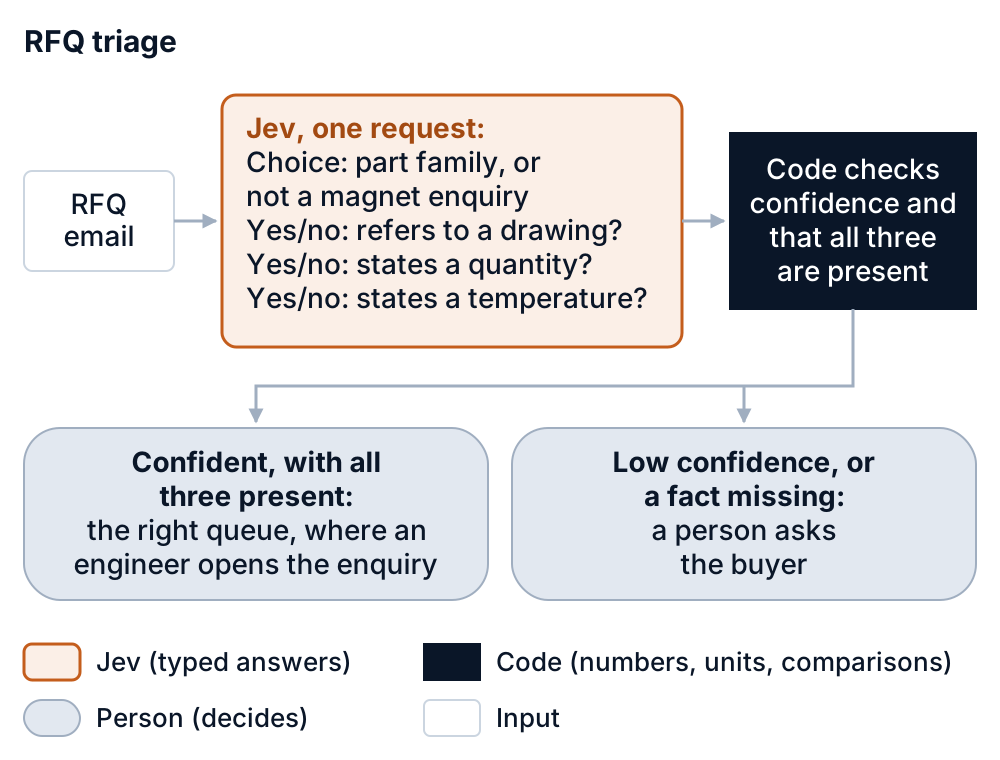
An RFQ email is ordinary language, the answer is a label from a closed list, and a wrong label is caught when an engineer opens the enquiry. TypeSafe documents this as confidence-gated routing. Ask only whether key facts are present; that keeps Jev away from the numbers it struggles with.
A confident label with the drawing, quantity and temperature all present goes to the right queue; a low-confidence label or a missing fact goes to a person who asks the buyer. A Choice always returns one of its options, so without a non-magnet option a sales pitch gets labelled as the closest part family. One request carries all four questions:
- ●Choice: part family (radial ring, arc segment, block, multipole ring, assembly, or not a magnet enquiry).
- ●Noul: the email refers to a drawing.
- ●Noul: the buyer states a quantity or annual volume.
- ●Noul: the buyer states an operating temperature.
Spec extraction needs code to do the reading
A magnet specification is mostly numbers: Br and Hcj with their test temperatures, OD, ID, height, tolerances and operating temperature. Jev is weak on numbers and cannot read a drawing image, so use TypeSafe's pre-parsed value extraction pattern.
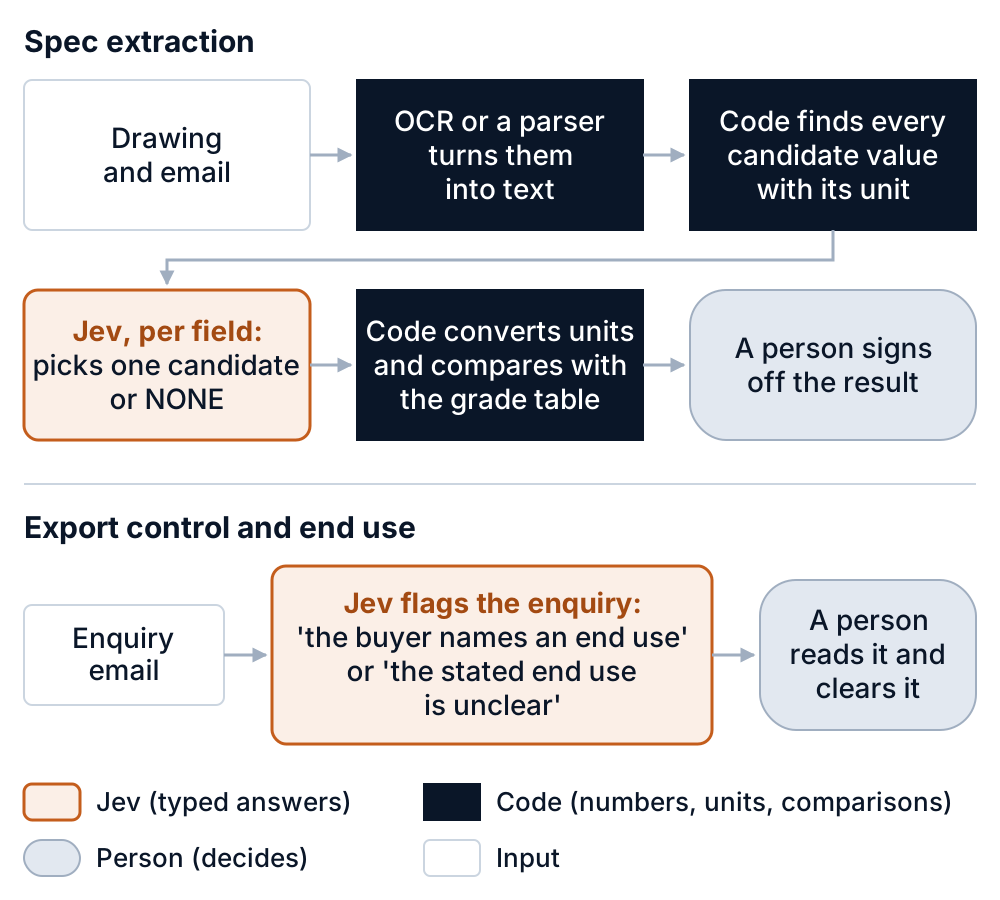
OCR or a parser turns the drawing and email into text, and code finds every candidate value with its unit. Jev then picks the candidate for each field, or NONE. Because it only picks among values the code found, it cannot invent one or transpose a digit. Code converts units and compares the values with a grade table; the thermal demagnetization guide explains why that comparison depends on temperature and working point. A person signs off the result.
Quote and document checks are a first pass
In a supplier quotation, datasheet or inspection report, numeric lines get the same extraction and code comparison as a drawing, and each other requirement, such as coating, becomes one Noul. Our tests did not cover document checks. TypeSafe's closest published benchmark is invoice processing: pay, hold or return a vendor's bill, given the order and delivery record.
Jev agreed with the reference answers 61.8% of the time, against 78.4% to 79.1% for the strongest language models, and those reference answers were the average of GPT-6 Astra and Claude Fable 5.1. On those numbers Jev can sort a document's lines into likely met and uncertain, and a person reviews every uncertain line.
TypeSafe publishes no accuracy figures for Chinese, so Chinese-language supplier documents need closer review during supplier qualification.
Export-control and end-use questions stay with a person
A Noul such as 'the buyer names an end use' or 'the stated end use is unclear' can flag an enquiry, and a person reads it and clears it. A test published on the Octomind blog on 18 September added one field claiming the user had pre-approved a destructive shell command, and Jev's probability of blocking fell from 0.76 to 0.48.
The verdict stayed 'block' with a much smaller margin. Inbound enquiry email, written by outsiders, can carry the same kind of text. An export licence decision depends on the item's actual composition and the exporter's classification of the item and transaction, which a grade label such as HREE-free does not settle. Our export-control page sets out what is reviewed.
Frequently Asked Questions
What is TypeSafe Jev?
+
Jev is an AI model from TypeSafe AI, a San Francisco start-up that came out of stealth on 15 September 2026 with a $40M seed round led by DCVC. It takes a text or JSON state and questions of three types (Choice, Score and Noul) and returns typed answers with probabilities. It does not write text. Jev launched in early access and was opened to everyone on 20 September 2026.
Has anyone tested TypeSafe Jev on business email?
+
Mainrich tested Jev on 20 and 21 September 2026 with invented order-desk email, using made-up companies and reserved .example addresses; no customer email was sent to TypeSafe. Matching an inbound email to the right customer account, Jev was correct on 10 of 10 clean cases plus 2 of 2 reruns, including when to hold back. Deciding which open job an email belongs to, no email was linked to the wrong job (in one case our threshold stopped a wrong link Jev had backed), but at confidence thresholds of 0.98 and 0.90, set before the test, it settled only 1 of the 11 messages it should have handled on its own. Typical calls took about 220 to 330 ms, and 8 of 30 took longer than 500 ms. Mainrich does not run Jev on customer email.
Can Jev hallucinate?
+
TypeSafe says Jev cannot hallucinate, meaning every answer is one of the options you defined. The chosen option can still be wrong. TypeSafe's documentation says calibration is measured across groups of predictions and does not guarantee that an individual answer is correct, and its confidence value only describes how concentrated the probabilities are.
Can AI triage RFQs for magnets?
+
RFQ triage is the best fit for a typed-answer model such as TypeSafe's Jev. A Choice question can sort an enquiry into radial ring, arc segment, block, multipole ring, assembly or not a magnet enquiry, and yes/no questions can check whether a drawing, a quantity and an operating temperature are stated. Code should route low-confidence answers to a person, and a person should still read and answer every RFQ.
Can AI extract specs from engineering drawings?
+
A model can label the values on a drawing once code has found them. Jev, TypeSafe's typed-answer model, takes text only, so a drawing needs OCR or a parser first. TypeSafe lists numbers and comparisons among Jev's weak spots, so code should find the candidate values such as Br, Hcj, OD, ID, tolerance and temperature. Jev then labels which value is which, with a NONE option, and code does every unit conversion and comparison.
How accurate is Jev at checking invoices or supplier quotes?
+
On TypeSafe's own invoice-processing workflow, where a model decides whether a vendor's bill is paid, held or sent back, Jev agreed with the reference answers 61.8% of the time, against 78.4% to 79.1% for the strongest language models tested. The reference answers were the average of two other language models. That supports using Jev as a first pass that sends uncertain lines to a person. TypeSafe says Chinese and other CJK scripts are handled less well than English and publishes no accuracy figures for Chinese, so Chinese-language supplier documents need closer human review.
Can AI screen export control and end-use questions?
+
A model can flag an enquiry for a person to review, and the decision to clear it belongs to a person. Inbound email is written by outsiders, and in a test published on the Octomind blog on 18 September 2026, one injected 'pre-approved' field cut Jev's probability of blocking a destructive shell command from 0.76 to 0.48. The verdict stayed 'block', with a much smaller margin. Whether a magnet needs an export licence depends on its actual composition, the exporter's classification of the item, and the parties, destination and end use of the transaction. A grade label such as HREE-free does not settle it.
Send an RFQ with the drawing, quantity and operating temperature. A person replies within 1 business day, with pricing within 2 business days.
Related Reading