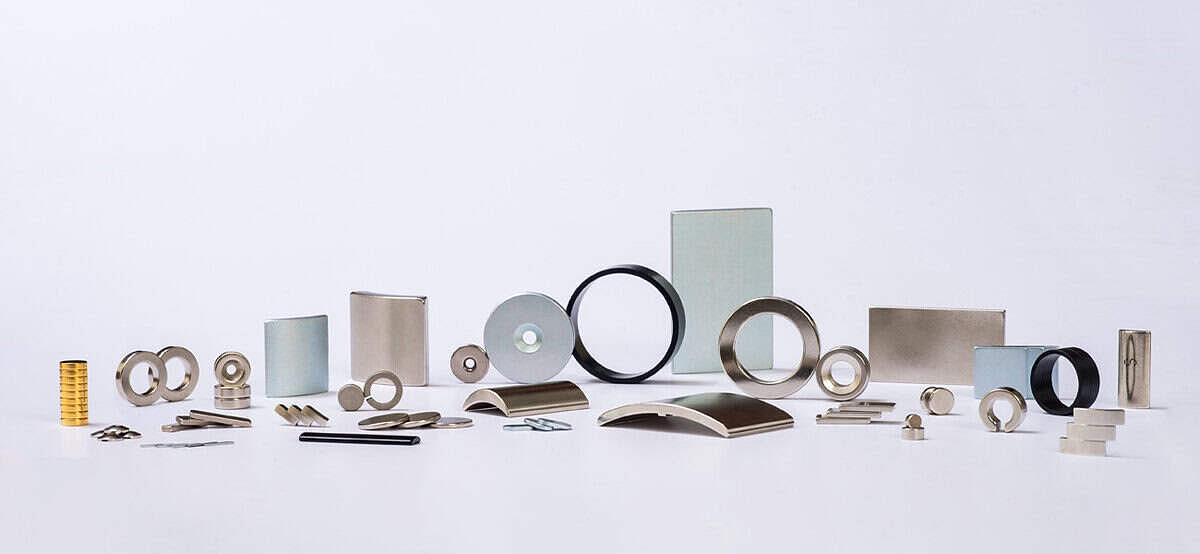
Radial multipole rings, integrated Halbach rings and arc segments for joint and servo motors. Mainrich reviews the construction, magnetic circuit and inspection requirements against your drawing.
Magnet and assembly examplesFinal configuration is confirmed against the drawing.
Engineering response within 1 business day · Pricing within 2 business days for standard requests
01 / Ring construction
Dimensions and magnetic pattern
Radial multipole and integrated Halbach rings use different orientation patterns. Confirm the required waveform and measurement method before selecting the construction.
Inspection features and acceptance limits are agreed for the part.
Radial-ring reference window
Outside diameter
20 to 75 mm
Inside diameter
15 to 68 mm
Wall thickness
2 to 7 mm
Height
5 to 50 mm
Dimensional tolerance
±0.05 mm standard within the documented radial-ring size window; tighter features require drawing review
Grade and poles
Confirm for the proposed geometry and production route
The endpoints are not a promise that every combination is feasible. This window does not apply to integrated Halbach rings. A stated ±0.02 mm critical-feature capability for that separate route requires confirmation per feature and drawing.
02 / Historical measurements
Three measured ring samples
November 2025, 10 poles, OD36.6 × ID29.8 × height17 mm. The KCS-906A reports are external OD surface scans.
Construction
Specimen grade
Mean positive peak
Reported trace
Radial multipole
N45SH
415.74 mT
Trapezoidal
Segmented ring
N50SH, historical specimen
521.39 mT
Segmented construction
Integrated Halbach
N45SH
629 mT
Sinusoidal
The samples differ in construction and the segmented sample also differs in grade. Probe standoff and measurement uncertainty are not recorded. These measurements do not establish air-gap field, back-EMF, torque ripple or a production-lot guarantee. The N50SH specimen is historical evidence, not a current Mainrich supply offer.
03 / Selection
Review the working circuit
Our company capability summary is N30 to N56. Radial-ring grade and temperature classes can be narrower. Geometry, hot demagnetisation curves, opposing field and the cooling path determine the material review.
Agree coating and bond-line requirements, magnetisation state, retention, tolerances, sampling and magnetic acceptance criteria. Certificate and documentation scope are confirmed for the supplying production entity and programme.
Include dimensions, tolerances, pole count, coating, continuous and peak temperatures, target field and measurement position, sample quantity and annual volume.
An engineer responds within 1 business day. Pricing follows within 2 business days for standard requests; further review and timing are confirmed in our reply.
Questions before an RFQ
Can we start with samples?
Send the drawing, evaluation requirements and sample quantity. We confirm the material route, tooling, price and timing before an order.
How is export classification established?
The material composition, finished item, end use and transaction require review. A grade suffix or series name alone does not determine export clearance.
Does a radial ring have a sinusoidal waveform?
Waveform depends on construction, magnetisation and measurement position. The historical radial sample had a trapezoidal OD surface trace; the integrated Halbach sample had a sinusoidal trace. These are different constructions.